The Reach Test: Why Deep Borders Are a Small-Garden Trap — and Three Fixes That Don't Need a Digger
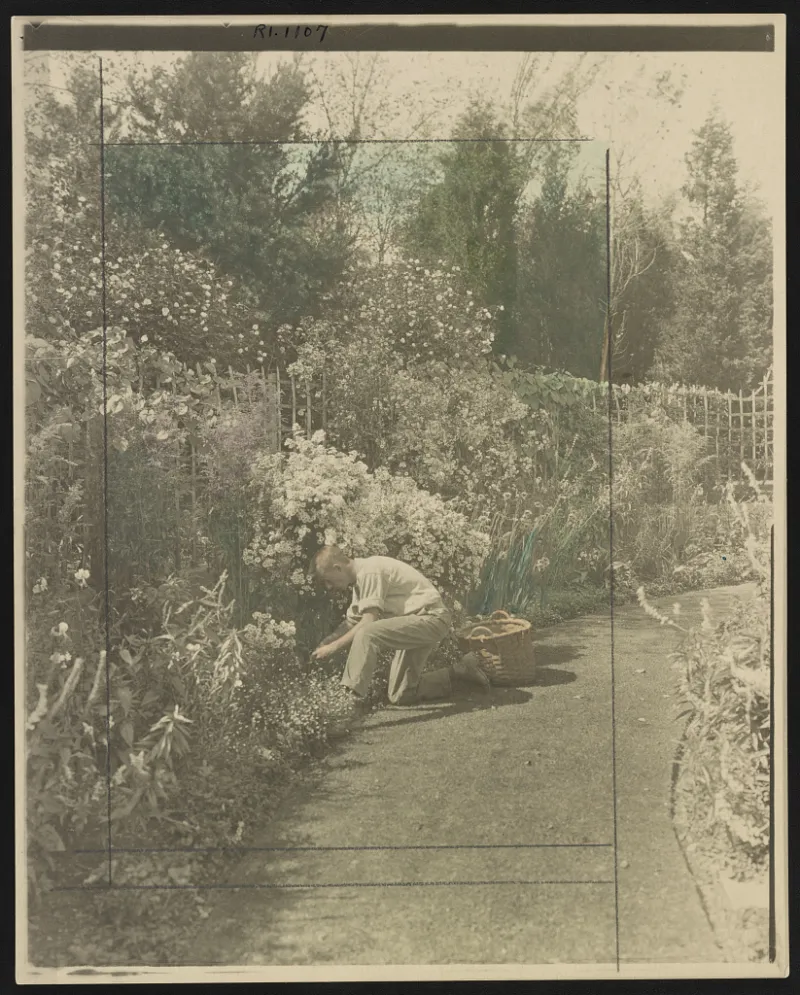
Photo: The Library of Congress, No restrictions, via Wikimedia Commons
There's a moment in every small garden where you lean into a border to pull a weed and realise your back foot is still on the patio. You stretch. Something snaps — either the weed or something you planted. Then you stand up, look at the bed, and think: right, that's too deep.
This is the most common design fault I see in British gardens, and it has nothing to do with taste. It's arithmetic. A border that's 1.2m from front edge to fence means you need a 60cm reach from each side just to touch the middle. Most of us don't have it. And the plants in that dead zone know it.
Measure your actual reach, not your optimistic one
Forget the standard advice. Measure yourself.
Kneel on a cushion or a kneeling pad at the edge of your border, as if you were about to weed. Keep your hips roughly over your knees — no cheating by lying across the bed — and reach forward with your trowel hand. Mark where the trowel tip lands. That's your working depth from that side.
Do it again standing, because some jobs happen on your feet. Then do it from the other side if you can get to it. Write the numbers down. Most people find their comfortable kneeling reach is somewhere between 50cm and 70cm, and their standing reach is longer but far less useful for actual work.
Now measure the bed. If the width is more than double your kneeling reach, you have a dead strip in the middle. That's your problem, and it's a design problem rather than a discipline problem.
What an over-wide border actually does
It isn't just awkward. A deep bed changes how the soil behaves. You can't get in to fork it, so it stays unaerated. You can't reach to pull out the annual weeds before they seed, so they don't. In wet UK winters — and on our beloved heavy clay — every step you take to reach that middle plant presses the structure out of the soil. Compaction is what happens when good intentions meet a bed that's too wide.
Then there's the plant damage. You don't step on things deliberately; you step on them because there's nowhere else to put your foot. A clump of hardy geraniums will forgive you once. It won't forgive you every weekend between March and October.
And the jobs you skip are the ones that matter. The middle of the border gets watered less, because it's a faff. It gets deadheaded less, because you can't reach. It gets forgotten, and eventually you redesign the whole garden around a strip you can't get to. That's a shame, because the fix is usually small.
Fix one: take the edge back
If your border is only slightly too deep — say 20cm to 30cm — narrowing it is the least disruptive answer. You don't need a full rebuild.
Mark a new edge line with a garden hose or a length of string. Lift the turf or the top layer of plants from the strip you're removing. If it's lawn, cut it into squares and stack them upside down somewhere out of sight; they'll rot down into decent topsoil. If it's planting, pot up anything worth keeping and move it to the new front line.
The removed strip can become a path, a gravel margin, or simply a mown edge. In a small plot, that lost planting space is usually worth less than the space you actually use. A 70cm border you can reach into is more productive than a 1.2m border you can't.
Fix two: put a route through it
If you don't want to give up the planting depth, give yourself a way in. This is the stepping-stone fix, and it works on almost any bed.
Set a line of flat stones, bricks or scaffold boards from the front edge into the middle, spaced at your natural stride. They should sit flush with the soil surface, not perched on top like little tables. On clay, bed them into a shallow scoop of sharp sand or grit so they don't wobble and don't trap water against the plant crowns.
One route is often enough for a border up to about 1.5m deep. Two routes crossing the bed give you access to every corner and make the whole thing feel intentional rather than improvised. The stones also tell you where to put your feet, which saves the plants, and they break up the visual mass of a large bed in a way that makes a small garden feel calmer.
Fix three: split the border with an edging line
This is my favourite for deep borders against a fence: stop treating it as one bed.
Run a simple edging line — timber, steel, or a narrow strip of paving — about 60cm to 70cm from the front, parallel to the edge. The front section becomes the reachable zone: low perennials, seasonal colour, anything you'll actually tend. The back section becomes the deep-planting zone: shrubs, ferns, taller things that don't need weekly fussing.
The beauty is that you haven't moved much soil, and you've created a clear maintenance boundary. You know which bit you're responsible for. The back section can be mulched once a year and left to get on with it. The front section stays within arm's reach, which means it stays looked after.
It also helps the design. A narrow front strip with a repeated low plant gives a border structure that a single deep mulch-and-shrub bed never quite manages.
The 60cm rule is a starting point, not a law
Not everyone's reach is the same, and neither is every garden. If you're tall, if you use a long-handled hoe, if your bed is raised, your working depth will be different. The point isn't to hit exactly 60cm; it's to design around the body that actually does the gardening.
So measure once, honestly. Then pick the fix that suits your plot. A narrower bed, a stepping-stone route, or a divided border. None of them require a landscaper, a digger, or a weekend you'll regret. They just require you to admit that a border you can't reach is a border you'll stop looking after.