Cold Air Has Favourite Corners: How to Find Yours and Make It Work
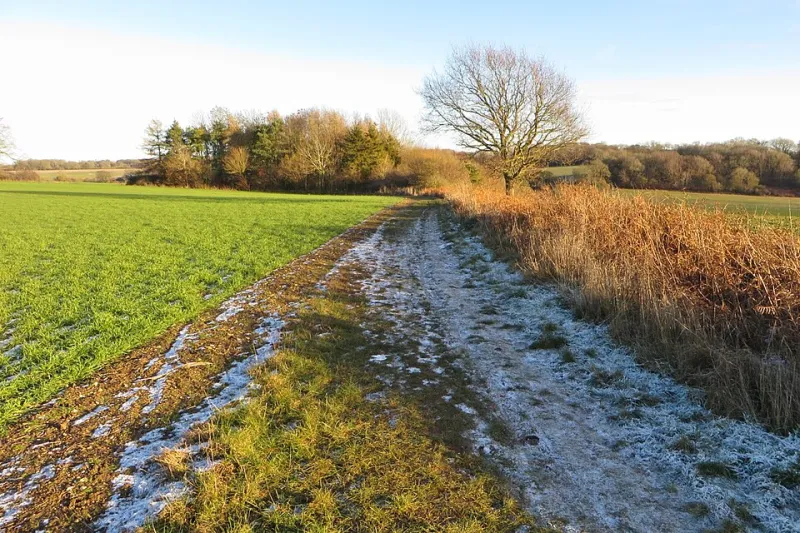
Photo: Philip Jeffrey , CC BY-SA 2.0, via Wikimedia Commons
Every garden has a coldest corner. Not the shadiest one, necessarily, and not always the one furthest from the house. It is the place where cold air collects on a still night, where the grass crunches first, where the fence panel looks damp until lunchtime, and where a tender plant quietly gives up in February. In a small UK plot, that corner can feel like a design problem. It is better treated as information.
By mid-November 2026, most of us are thinking about putting the garden to bed rather than redesigning it. But this is exactly the right moment to watch how your plot behaves. A few frosty mornings, a cheap thermometer, and a rough sketch will tell you more about your garden’s microclimate than any amount of online browsing. Once you know where the cold settles, you can stop fighting it and give that corner a job.
Start with a frosty morning walk
Pick a morning when there is frost on the lawn, or at least a proper chill in the air. Go out before the sun has done its work, ideally before you have had your second cup of tea. Walk the boundaries slowly. Look for the places where white frost lingers longest, where gravel looks darker, where water sits in a saucer, and where the soil feels stiffer underfoot.
Do not just look at the ground. Look up and around. Cold air moves like water: it drains downhill, pools behind obstacles, and escapes through gaps. A solid fence at the bottom of a slope can trap cold air on your side. A hedge with a bare bottom can let it flow through. A shed, a log store, or a raised bed can all create small eddies. In a small garden, these effects are amplified because there is less room for the air to mix.
Make a simple sketch. It does not need to be pretty. Draw the boundaries, the house, the shed, the patio, the beds, and the main paths. Then mark the frosty patches with a pencil. Add arrows for where you think cold air comes in and where it gets stuck. If you have a max-min thermometer, put it in the suspect corner for a few nights and compare it with a spot nearer the house. You are not collecting data for a science project; you are learning the shape of your plot.
Read the gaps, not just the fences
A frost pocket is rarely caused by one thing. It is usually a combination of level, enclosure, and airflow. On a slope, cold air drains to the lowest point. Behind a solid boundary, it stacks up. In a narrow side return, it funnels. Under a dense evergreen hedge, it sits still and damp.
The fix is not always to tear down the fence or cut down the hedge. Sometimes it is enough to open a gap at the base, swap a solid panel for a slatted one, or lift the bottom of a hedge so air can move. If your garden slopes towards the house, a shallow swale or a gravel-filled channel can help move water and cold air away from the sitting area. If the cold corner is also the wettest corner, deal with drainage first. Cold and wet is a miserable combination for plants and for anyone trying to work there.
Think about where you actually need warmth. A small seating area, a greenhouse, a potting bench, or a line of pots for tender herbs should not be in the frost pocket. Move them to the warmer side of the plot, even if that means redrawing your original plan. The coldest corner can then become a functional zone rather than a place you keep trying to make into something it is not.
Give the cold corner a proper job
Once you know where the cold sits, you can design for it. One option is a hardy winter cropping bed. In a UK frost pocket, think tough and steady rather than exotic: kale, cavolo nero, leeks, purple sprouting broccoli, winter salads under a cloche, and broad beans started in pots for an early spring planting. These are not glamorous crops, but they earn their space. A raised bed can help, not because it magically warms the air, but because it lifts the soil out of the coldest, wettest layer and improves drainage. Just do not make it so tall that it blocks the airflow you are trying to encourage.
Another option is a shed-side nursery. The north or east side of a shed is often cold and overlooked, which makes it a sensible place for a water butt, a stack of pots, a sand tray for cuttings, and a small frame for hardening off plants. It will not be a suntrap, and that is fine. A cold frame in a frost pocket needs careful management, but it can work for hardy seedlings and spring holding if you vent it on mild days and insulate it on hard nights.
The third option is a spring holding area. Many of us buy or split plants in autumn and then wonder where to put them. A cold corner with a gravel base, a few sturdy crates, and a layer of bark mulch can hold dormant perennials, bare-root hedging, and pots of compost until spring. Label things. Cold corners have a way of turning into lost-property shelves.
Plant for the conditions you have
Be honest about the pocket. If it is cold, damp, and slow to warm in spring, choose plants that cope with that rather than plants that merely survive it. Hardy ferns, hellebores, snowdrops, winter aconites, dogwood for winter stems, and tough evergreens such as holly or yew can all earn a place. For ground cover, consider hardy geraniums, epimedium, and ferns rather than tender lavenders or rosemary, which may sulk through a wet British winter.
Mulch is your friend. A generous layer of well-rotted compost or leaf mould in late autumn protects soil structure and roots from repeated freezing and thawing. It also signals that this corner is cared for, not abandoned. Keep off the soil when it is frozen or waterlogged. Walking on a cold, wet bed does more damage than the frost itself.
Finally, revisit your sketch in spring. Notice which plants came through, where the soil dried first, and whether your airflow changes made a difference. A frost pocket is not a life sentence. It is a quirk of your plot, and quirks are what make a garden feel like somewhere real. Find the cold corner, give it a job, and your makeover will work with the weather instead of pretending it does not exist.