After the Rain: A 20-Minute Water Walk That Saves Your Garden Makeover
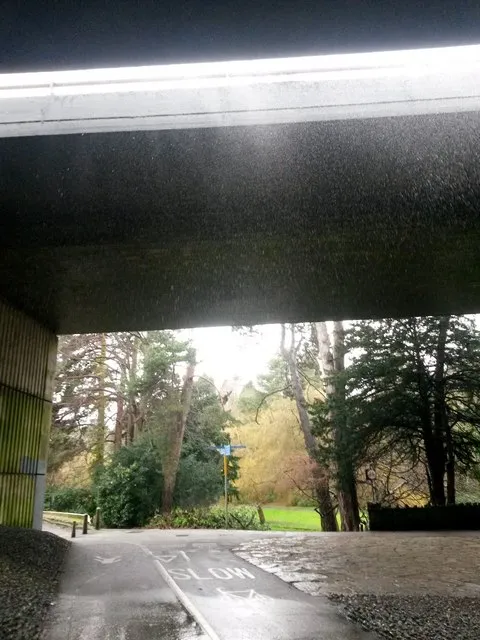
Photo: Chris Downer , CC BY-SA 2.0, via Wikimedia Commons
Most garden makeovers begin with a moodboard. That is fair enough — everybody needs something to aim at. But before the first bag of gravel lands on the drive, it is worth giving the garden itself a vote. And the garden votes with water.
After a decent bout of British rain, your plot tells you exactly where it is unhappy. The low corner that turns into a pond. The strip beside the fence that stays squelchy for days. The paving that sends a thin sheet of water towards the house. None of this is a disaster. It is information. And it is free.
This is not a full drainage survey. It is a practical first pass: a rainy-day walk, a rough sketch and a short list of fixes in sensible order. Twenty minutes now can save you from paving over a problem, planting into a bog or building a raised bed in the one spot that should have been left alone.
Go out while it is still wet
Wait for proper rain — the sort that fills the gutters and makes the lawn go soft underfoot. Then put on boots, grab a notebook, a pencil and your phone, and walk the garden before it has had a chance to drain.
You are not trying to be scientific. You are trying to notice. Where is water standing? Where is it moving? Where has it left a tidemark of silt or a patch of darker soil? Take photos as you go, because wet patches have a habit of looking imaginary the next morning.
If it is tipping down, wait until it eases. You want to see the water, not get blown into the neighbour's shed.
First pass: the edges and the house
Start at the house and walk the boundary. Look at the base of the wall, the side return, the fence line and any retaining walls. This is where water does the most expensive damage, so it gets first attention.
Check the gutters and downpipes. Is water pouring out of a joint rather than going down the pipe? Is the downpipe emptying onto a path that slopes back towards the house? Is there a gully that is quietly stuffed with leaves? These are cheap fixes, but only if you spot them.
Look for staining on walls, damp patches on fences and gravel that has been washed into a neat fan shape. That fan shape is a useful clue: it shows you where runoff is leaving the pipe or crossing the surface.
Second pass: the middle of the plot
Now walk the open garden. Look for standing water, squelchy grass, moss, rushes or plant bases that are sitting in a puddle. A lawn that holds water in the same place every winter is usually telling you about a low spot, compacted soil or both.
Do not dig yet. Wet clay is not a digging matter; it is a waiting matter. But you can probe gently with a fork or a cane in a few spots to see how far it sinks. If it stops hard a few centimetres down, compaction is a likely suspect. If it goes in easily and the hole fills with water, you have found a genuine low point or a high water table.
Mark the worst spots with a cane, a plant label or a photo. Keep it simple.
Third pass: paths, patios and other hard surfaces
Hard surfaces are brilliant at revealing levels. Watch where water sheets across paving, where it pools in joints and where it disappears off an edge. Check whether the fall is going away from the house or quietly towards it.
Look at gullies, channel drains and gravel margins. Are they clear? Are they level? Is the path acting as a dam, holding water in a border because there is nowhere for it to go? A path that drains beautifully into the lawn is not draining at all — it is just relocating the problem.
Fourth pass: soil and planting beds
In the borders, look at the soil surface rather than the plants. Is it capped and smooth, like a sealed lid? Are there worm casts, moss or algae? Does water sit in a saucer around a shrub? These are clues about structure and drainage.
Be honest about what you are seeing. A border that is wet in January may be perfectly fine in June. The point is not to condemn the whole garden. The point is to find the handful of places where water is being trapped, concentrated or sent somewhere it should not go.
Sketch it before you forget it
Back indoors, draw a rough outline of the garden. Mark the house, the boundaries, the main paths and any hard surfaces. Then add arrows for water flow and shaded blobs for standing water. Note the date, how long the water took to drain and anything that looked blocked or broken.
This sketch is more useful than a dozen half-remembered observations. It becomes the base layer for your makeover plan. If you are planning to pave a seating area, dig a border or put in a shed, you can check it against the wet spots before you commit.
The likely suspects
Most small-garden water problems come down to a short list. Compaction is common, especially on new-build plots and lawns that have been walked over for years. Levels are another: a garden can look flat but still have a shallow bowl in the middle. Blocked drainage is often the easiest fix — clear the gully, clean the gutter, lift the leaf fall from the drain cover. A buried or disconnected downpipe is also surprisingly common, especially where extensions and old patios have been added over the years.
Then there is the source problem. Water coming from a roof, a neighbour's driveway or a raised bed uphill will keep arriving no matter how many holes you poke in your lawn. Find the source before you design the destination.
Turn it into a prioritised fix list
Once you have your sketch, sort the fixes into order. First, anything that puts water near the house or wastes it from a downpipe: clear gullies, repair gutters, extend downpipes into a water butt or a planted gravel area. Second, source control: redirect roof runoff, clear channels and stop paths acting as dams. Third, cheap ground fixes: aerate compacted lawn, fork the worst border when conditions allow, add organic matter and mulch. Fourth, design changes: a shallow swale, a rain garden, adjusted paving falls or a gravel margin.
That order matters. There is little point spending a weekend building a decorative soakaway if the gutter above it is still overflowing into the same spot.
What not to do
Do not rotovate or dig saturated clay. Do not pave over a wet patch and hope. Do not assume a French drain will fix a problem that starts at a blocked downpipe. And do not plant bog plants unless you have actually created a bog — most plants hate sitting in winter water, even if they look fine in summer.
The rainy-day walk is not glamorous. You will get wet. But it is the cheapest design tool you own. Do it once after heavy rain, sketch what you see, fix the obvious sources and then plan the good stuff. The garden will drain better, the makeover will last longer, and you will have a proper reason for where everything goes.