Bin Day Is Not a Design Brief: Giving Britain's Front Garden a Proper Makeover
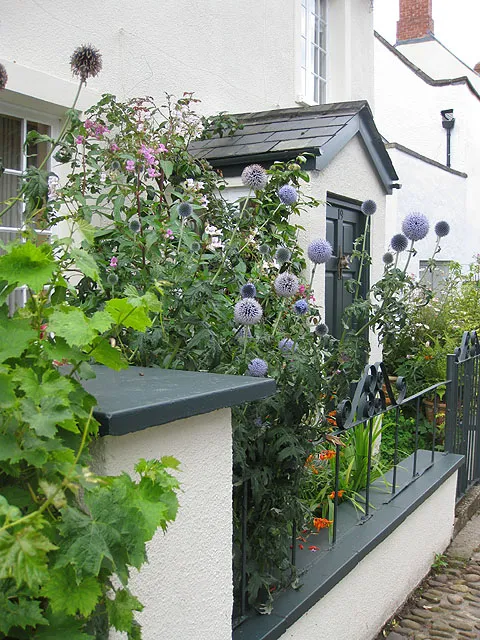
Photo: Pauline Eccles, CC BY-SA 2.0, via Wikimedia Commons
Somewhere over the last thirty years, the British front garden quietly gave up. It became a parking space, a paved rectangle for the recycling boxes, and a home for three varieties of gravel. Meanwhile the back garden gets the pergola, the raised beds and the carefully chosen perennials.
I think that's a mistake, and not just for the sake of kerb appeal. The front garden is the bit of your property you see every single day, and it's the bit everyone else sees too. It deserves a plan.
Six square metres is a real garden, not a leftover
Most terraced and semi-detached front plots in the UK come in somewhere between five and fifteen square metres, minus whatever the car takes. That's more than enough for a path, a couple of structural shrubs, some seasonal colour and a place to put the bins that doesn't look like an afterthought.
The trick is to treat it like a small room rather than a leftover strip. Rooms have circulation, boundaries and something worth looking at. Front gardens usually have two out of three.
Start with an honest light survey
Before you sketch anything, watch the space. Note where the sun lands at 9am and where it lands at 3pm, and which bits get nothing but a grey wash from an east-facing wall. In November 2026 you'll see the worst of it; that's useful information, not a reason to put it off.
South and west-facing front plots can take lavender, rosemary and sun-loving perennials. North-facing ones want ferns, hydrangeas, hellebores and anything that shrugs off dry shade. Get this wrong and you'll spend three years replacing plants that never had a chance.
Decide what the space has to do
Be brutally practical here. Does a car need to park? Two bikes? A bin store for three households in a converted terrace? Write the function list down, then design around it instead of pretending it doesn't exist.
If parking is genuinely needed, fine — but use a permeable surface like gravel or a grass-reinforced grid rather than solid tarmac. It looks better, it deals with rainwater, and it helps stop the drain outside your door doing all the work during a downpour.
The path is the spine of the design
A front path is the strongest line in the whole composition, so don't let a builder lay a straight strip of concrete and call it done. A gentle curve, a change of material, or simply a path that's wide enough for two people side by side transforms how the whole plot reads from the street.
Width matters more than pattern. Aim for at least 90cm clear. For material, clay pavers, riven stone or self-binding gravel all handle UK weather well; avoid anything slippery underfoot when wet, and remember that anything laid flush with a grass edge will need a proper edge restraint or it'll wander by spring.
Plant for structure first, colour second
In the front garden people see it in passing, at speed, in bad light, half the year. That means strong shapes and evergreen bones matter more than a long list of perennials.
Good starting points: a pair of evergreen shrubs either side of the path — sarcococca for scent in winter, or a compact euonymus where space is tight. Add a small multi-stem tree if there's room above the boundary wall. Then layer in bulbs for February and March, and a few long-flowering stalwarts like geraniums, nepeta or hardy salvia for summer.
Ignore the temptation to buy everything at once. Three plants repeated down a border always looks more confident than ten different ones crammed together.
Bins need a home, not an apology
Every front garden in Britain has a bin problem, and most of us solve it badly. A simple timber slatted screen, 1.2m high, with a lift-off panel or a hinged gate, hides three bins neatly and doubles as a windbreak for tender plants. Trellis on top and a climbing rose or jasmine softens the whole thing within two seasons.
If space is really tight, build the screen tight against the house wall and put the bins behind it in a row. Just leave yourself a route to wheel them out on collection day — design that in now, because you'll curse it otherwise.
Boundaries: friendly, not fortress
A low wall, a hedge, or a run of simple post-and-rail does more for a front garden than a 1.8m closeboard fence ever will. You want a boundary that says 'this is looked after' without saying 'keep out'.
A box or yew hedge at 60–80cm gives a crisp edge and needs one trim a year. In small plots, a low hedge also frames the planting beautifully and hides the slightly chaotic bottom of the shrubs behind it. Just leave a gap for the postie.
Kerb appeal without the fuss
If you're doing this partly with an eye on selling, focus on the things a photo picks up from the pavement: a clear path, a tidy edge, one strong plant repeated, and no visible clutter. Estate agents talk about kerb appeal because buyers genuinely do make up their minds from the car.
But even if you're staying put for twenty years, the same things make the plot nicer to come home to. A well-edged path and a healthy hedge cost almost nothing and change everything.
A realistic weekend schedule
Weekend one: clear the site, measure up, and take photos. Weekend two: lift the old paving or gravel, sort out drainage, and set out the path line with a hose or string. Weekend three: lay the path and build the bin screen. Weekend four: improve the soil with compost and plant the structural shrubs. Weekend five: bulbs, mulch, and a final tidy.
It won't look finished. Nothing does in its first winter. But come April, when the bulbs push through and the hedge starts greening up, you'll have a front garden that looks deliberate — which is all any of us are really aiming for.